

When It Started to Change
When my wife first started to experience perimenopause symptoms she didn’t know what they were. The sleeplessness, the sudden changes in mood, the strange hip pain that appeared out of nowhere.
Successive doctors dismissed her symptoms as aging, diet, the need for more exercise, even repeated UTI’s. Her labs were “normal”. You probably aren’t that surprised by this. Most doctors aren’t trained well, if at all, to recognize and be able to diagnose women in the menopause transition.
When It Became About Me
One of the side-effects of her symptoms was a withdrawal from intimacy. Not just physical, but emotional intimacy. Like most men I used that intimacy as a barometer for the health of the relationship. Without it to measure our relationship, I immediately jumped to the conclusion that the relationship was failing. And if it wasn’t my wife that was the problem, after all her labs were normal, then the problem must be me.
Personalization is not an uncommon reaction in men to changes in a relationship. It becomes about you, as a man, not part of a bigger transition within the relationship. This is certainly where I went. There was no other explanation in my mind. That led me to question why it was my fault. Was I doing things wrong? Was I no longer attractive? Was it because I was not as successful in my work as she was? How was I failing her and our relationship, and what could I do to fix it?
Finally, a Name for It
This struggle continued for four years, before my wife finally met a doctor who recognized her symptoms, not as a series of unconnected ailments but holistically and as part of one transition. Finally my wife was getting answers and offered options to how she might better cope with these symptoms.
Now we had language that could be used to describe what was going on. Perimenopause was the guilty party, not me. What didn’t happen with this new knowledge was a reset to our relationship. The intimacy was still lacking, and so I was still unsure of what Perimenopause meant for our relationship.
Was this just how things were in relationships that reached this point in life? Were we doomed to simply drift along becoming little more than roommates? The problem I was facing was I had a list of symptoms, I had language, I could even describe what some of the symptoms meant. I knew what a hot flash was, I even had an idea of the biology involved behind them.
What I Was Missing
What I was missing and this is the piece I think a lot of men miss, is what did that mean for my wife. What was a hot flash like for her, not what was it described as on a website, or by an influencer. I didn’t ask those questions. I was still at the personalization stage. This is happening to me and now I have to live with it.
This continued for another two years. I wasn’t asking the right questions, she was overloaded and overwhelmed by this transitional stage in her life. She didn’t have either the capacity or the mental bandwidth to educate me as well as herself.
She eventually made the decision, after discussion with her doctor, to try Menopausal Hormone Therapy (MHT). Before I continue, yes this was a privileged decision, MHT is not available to all women, for some it isn’t a viable option medically and for many it isn’t a financial option. It was, however, a pathway that was available and viable for my wife.
She started with a pill based treatment. For her this was real progress. She now had a doctor who listened to her, believed her symptoms were real and wanted to help her. What she didn’t have was a partner who was doing the same things.
At this point I was still stuck in the “Why is this happening to me?” stage. Even though I now knew I wasn’t failing the relationship in the way I thought I was, I was still personalizing it. I was missing an important piece of the puzzle, my wife’s lived experience. It hadn’t occurred to me to step outside my experience of this situation and try to see what her experience was.
My wife is very logical. She is a scientist. She deals in facts. I’m an artist, I deal in emotions. Some people would say we aren’t a good match. But the fact is we complement each other in many ways. She brings a grounded approach to situations that I sometimes am too deep in emotions to see properly. I help her see the humanity in situations that she might have only seen data in.
Being a logical person, she isn’t prone to emotional outbursts. She is very measured in her response to almost every situation. I don’t mean to paint a picture of an emotionless person without empathy. She is one of the most empathetic people I know, she just doesn’t lead with emotion.
We were discussing our relationship in broad terms one day, in of all places, the kitchen. I don’t remember the exact conversation, but I do remember that our positions were entrenched in our way of viewing things. I was very emotional about the situation, she was very practical about it.
But as the conversation carried on, she became increasingly agitated. She couldn’t understand why, if I was so connected to emotions, that I couldn’t see what she was going through.
And then came the break.
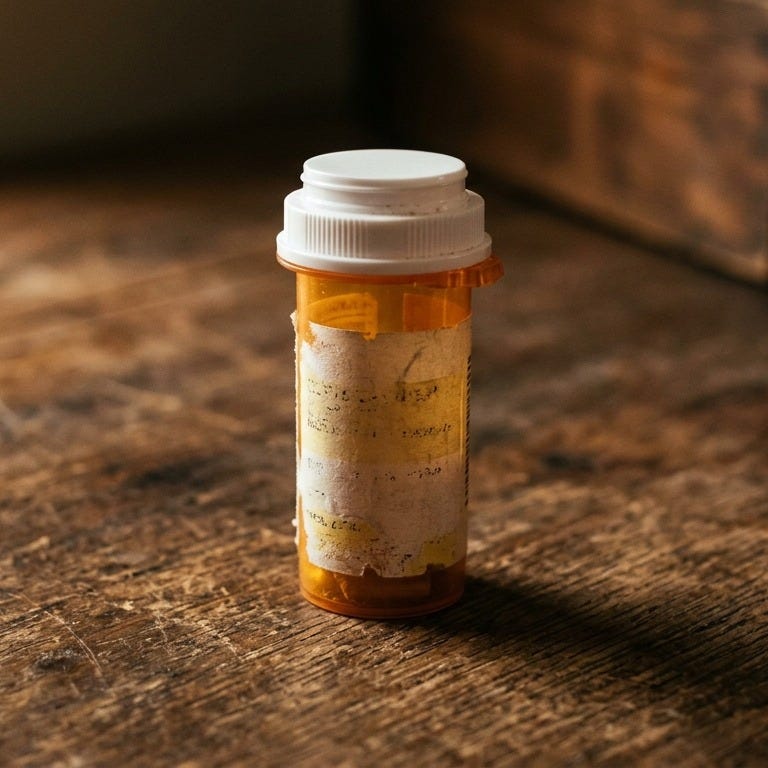
She picked up her bottle of pills and threw it at me.
The Pill Bottle Between Us
I stood there stunned. Never once in our relationship had she ever shouted at me, let alone thrown something. And suddenly everything snapped into focus. I understood what I had been missing, by personalizing the stage we were going through I had missed her experience completely.
The pill bottle lay between us. It could have so easily marked the breaking point in our relationship.
Instead it became a bridge bringing us closer together. For something to have caused her to snap so completely it must be very serious. I started to ask the right questions. She started to see how I was experiencing loss.
Over time, we’ve rebuilt our relationship on a new understanding. Intimacy returned as we both re-discovered what that meant for us. She has continued on her MHT journey and, while still experiencing various, and sometimes, completely random symptoms, she is now able to communicate those to me in ways that help me understand the how, not just the what.
In turn I took on the task of educating myself. I am a voracious reader. And so I read and read. Dug deeper and deeper so that I could better understand what we were facing.
We aren’t a perfect couple, I don’t believe there is such a thing. But we are better communicators.
And I have a pill bottle, both a physical reminder and a metaphoric reminder of where we were and how far we have come.
This substack runs on copious amounts of tea. If you’d like to support it you can buy me a cuppa.
Simon, I can only imagine how difficult this was to write, let alone share so openly. Thank you for inviting us into such a personal part of your lives. It’s rare to hear this experience articulated from the perspective of a partner, and your honesty around the confusion, the frustration, and the lack of language is incredibly powerful.
This kind of openness is such a gift, not just to women navigating perimenopause, but to the couples trying to find their way through it together.