
Menopause is not a woman's issue
It's A Human Issue

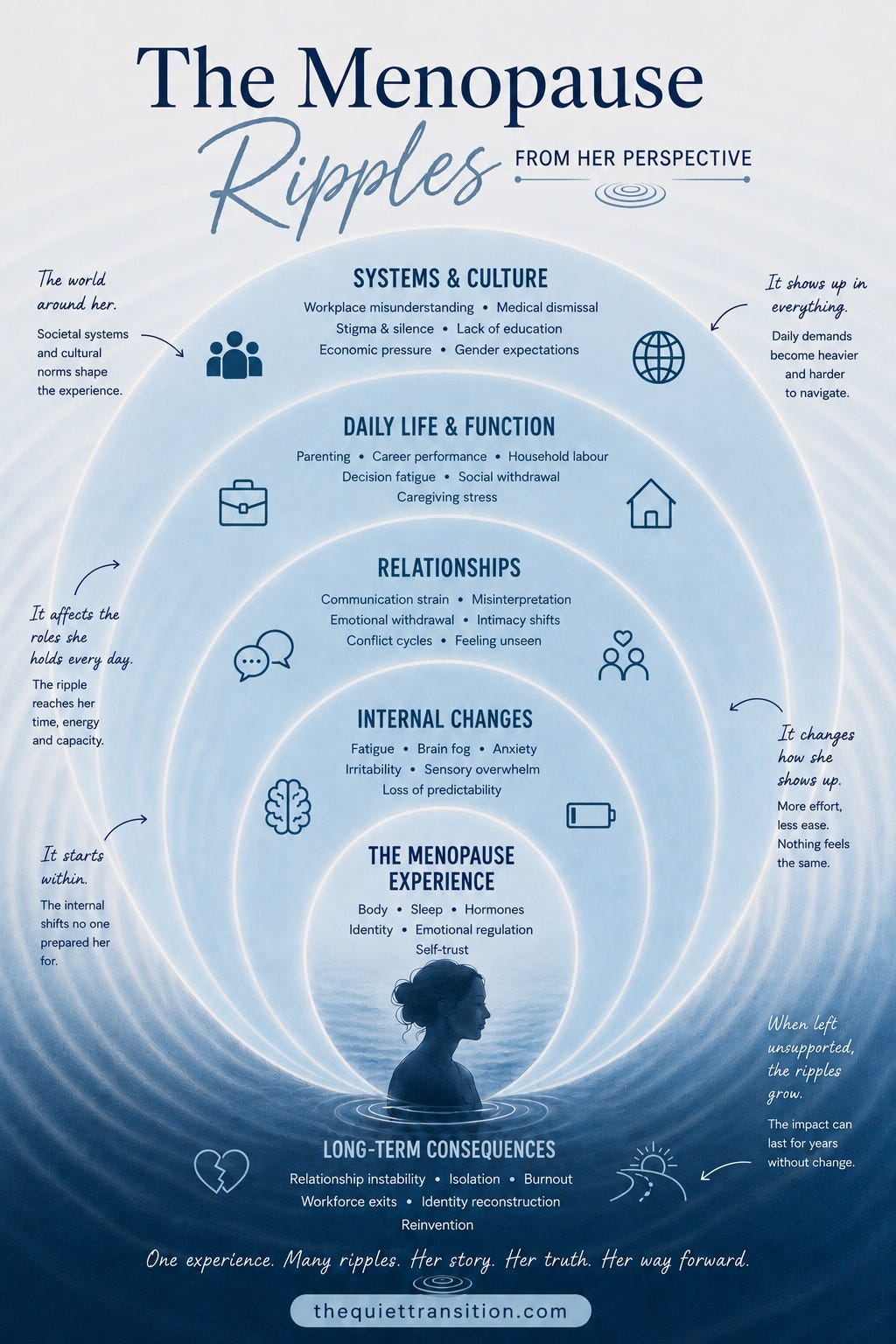
I’ve been thinking a lot about how the impact of menopause ripples out from a woman.
It Starts Within
It starts with her symptoms, and how they have an impact on her and how she shows up.
That is the first ripple, the way her life changes. From the ever popularized “Hot Flash” and “Brain Fog” to the lesser known symptoms, the unexplained aches and pains, things like “meat ick”. The itchy ears. The mood swings and the irritability. The lessening of a desire to put up with things that have gone unsaid, perhaps for decades. Sensory overwhelm. A loss of interest in things that used to bring her joy. The sheer effort of holding it all together without support.
Each of these as symptoms on their own would be enough for most people. But there are anywhere between 35 & 100 symptoms, depending on which literature you are consulting. On any given day a woman can wake up with any combination of these or none at all. Without being able to predict which the day will bring.
The Relationship Ripple
The internal becomes interpersonal. The loss of physical and emotional intimacy, and the impact that has on the relationship she is in. The cycle of conflict. The strained communication. The sense of not being seen.
A confused partner who, without understanding and language may internalize and personalize the experience. Withdrawing just at the moment their partner needs them the most.
Men personalize because they have no other cues. If they can’t fix what is wrong then they are failing the relationship. Not realizing that there is nothing to fix. The distance they are feeling isn’t the relationship failing, it is a readjustment to a new reality. Without the knowledge they need they can’t engage in productive conversations. “I want to help, I just don’t know how”, is something I have heard from men when talking about their early experiences with the menopause transition.
They aren’t alone. Often their partner doesn’t know what help they want. They can’t express it, it comes out in pieces, sometimes emotionally laden and at other times so directly it leaves a mark.
The Weight of Daily Life
The interpersonal then becomes functional. Children, who suddenly find that Mom is somehow “different”. Domestic, emotional and physical labor become bigger issues. The answer to the evergreen question “What’s for dinner?” becomes less predictable. I’ve spoken to women who have said if they could have one major change in their lives it would be to never hear that question again. Not because they don’t enjoy the role of caregiver or even cooking. It is the emotional labor required to answer it. I have had conversations with men who say they help. They do the grocery shopping. Then it is pointed out to them, they didn’t check the pantry and the refrigerator or create a meal plan for the week or write the list that they took to the grocery store. And suddenly a light bulb comes on and they can see the weight of emotional labor their partner has been carrying. Not just recently but perhaps for decades. Then there is a school event that is missed off the calendar and suddenly Mom is unreliable. Aging parents that now require her to increase her caregiving. During menopausal age, it is common for couples to move into the “Sandwich Generation”, children are growing and perhaps leaving home, parents are aging and require more attention.
When Systems Fail
Then the functional becomes systemic. Dismissal by the medical system, a lack of belief, “you’re too young”, “your symptoms aren’t connected” etc. An overall lack of education. The stigma of “aging”. The expectation that women remain youthful to be functional, to have value. So women delay seeking help, they put it down to aging, to being over emotional. They double down on diet and exercise, trying to out run something they don’t recognize as being hormonal because they haven’t been given that information.
When medical care is offered it is often offered for “depression” and so anti-depressants are prescribed instead of a deeper more meaningful conversation happening. And this isn’t surprising given how little education most doctors receive about the menopause transition.
This translates into the workplace as well. HR policies and management systems that aren’t structured to help employees. Performance reviews become a solution to a woman whose performance has changed, without ever asking why. She doesn’t speak up because she is tired of justifying her symptoms and the way she feels or simply because she doesn’t want to be a burden.
That lack of support has bigger implications downstream for organizations. Women start to step back, presenteeism and absenteeism become more common. Women start to cut back on the load they carry and some even leave the workforce itself.
The Ripples Keep Moving
Ripples go out beyond these. The partner who is now feeling rejection and confusion takes that with them to their world. If they work then it can spill over into their work relationships. Suddenly that easy going co-worker or manager has become a bear to work with. People start to reassess whether they can continue to work with them. People don’t typically leave jobs, they leave managers. They react to stress without knowing the source. So companies start to see this impact as attrition, without even knowing why.
Children take this change to school or college, they see and feel the strain their mother is under, they experience the sudden strain of their parents relationship.
Marriages can become transactional, conversations focus on logistics and whose turn it is to carry out certain tasks. Constantly circling but not touching on the root cause of the distance.
All this can leave the woman unrecognizable to herself, not just physically, though that happens as well, but emotionally. Is she too difficult, asking too much? Has she simply become unreliable personally and professionally?
The impact may start with the woman but it ripples beyond her in many ways. And like all ripples they return to the center. And those ripples returning bring their own cost. The erosion of the sense of self.
Want to add to the conversation. Leave a comment. I reply to them all.
This substack runs on copious amounts of tea. If you’d like to support it, you could always buy me a cuppa.
Yes! Menopause is the growth and ascension of humanity.
As women begin to change the narrative of menopause for ourselves and begin to embrace her mysteries, changes and upgrades, the the world is upgraded too.